
What if the repetitive work behind a literature review no longer had to hold your project back? At LEXQARA, we combine two-stage AI-assisted screening, human review at both stages, and rapid structured data extraction to help you move from a list of articles to usable clinical evidence.
Literature screening is essential to clinical and regulatory work. It is also demanding: titles and abstracts must be assessed, full-text articles reviewed, inclusion and exclusion decisions documented, and relevant data extracted consistently. When handled manually, these activities can occupy teams for weeks.
Our approach is designed to reduce that burden without removing expert judgement. AI handles repetitive screening and extraction tasks; consultants review and validate screening decisions. Your team receives documented results and structured article summaries—not simply a list of AI-generated answers.
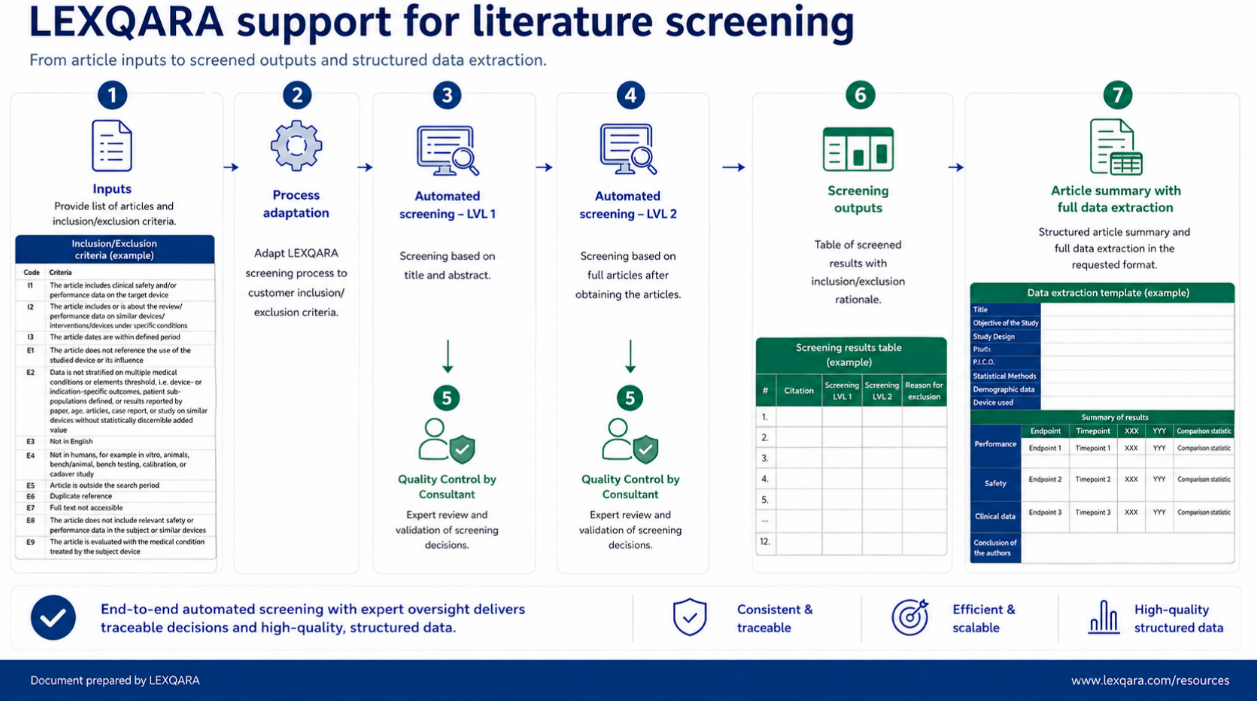
One connected workflow, from article list to structured evidence
Screening and data extraction are often treated as separate tasks. We bring them together in a workflow adapted to your project, so that the articles retained through screening can feed directly into structured summaries and the data fields you need.
1. Define the scope and adapt the process
You provide your list of articles and your inclusion and exclusion criteria. We adapt the screening process to your objectives, target device or clinical context, and the evidence you need to identify.
This starting point matters. Relevant evidence depends on the question being asked: the population, intervention or device, outcomes, study characteristics and review period may all influence eligibility. A clear scope helps ensure that the same decision framework is applied throughout the review.
2. Phase one: screen titles and abstracts
The first screening level assesses titles and abstracts against the agreed criteria. AI-assisted automation helps process the initial article set efficiently and consistently, identifying references that should progress to full-text assessment.
A consultant reviews and validates the screening decisions. Human review is part of this stage—not an optional check added only at the end. It provides the opportunity to assess how the criteria have been interpreted before the review advances.
3. Phase two: assess the full-text articles
The second screening level examines the full articles once they have been obtained. This allows eligibility to be assessed against information that may be absent from an abstract, including detailed methods, population characteristics and the relevance of reported results.
A consultant again reviews and validates the screening decisions. This second human-review point keeps expert judgement involved where the evidence is more detailed and decisions may require closer interpretation. Access to the full text remains a prerequisite for full-text screening.
4. Deliver screening results with documented rationales
You receive a structured screening table showing the references, the decisions at each screening level, and inclusion or exclusion rationales. These outputs make the selection process traceable and reviewable, helping your team understand not only which articles were retained, but why.
5. Turn retained articles into structured summaries and extracted data
We couple screening with article summaries and detailed data extraction in the requested format. Depending on your project and the information available in each article, the extraction template can include:
- Study objectives, design and population characteristics.
- Device or intervention studied and relevant comparator information.
- Statistical methods and demographic data.
- Performance and safety endpoints, time points and reported results.
- Relevant clinical findings and the authors’ conclusions.
The objective is to produce precise, consistently organised information that your team can work with—not a generic summary that omits the details needed for evidence assessment. The scope and depth of extraction are defined around your intended use.
From weeks of manual effort to a much shorter processing window
The combined effect of automated screening and rapid extraction can be substantial. For a suitable, clearly defined article set with the necessary source material available, the AI-assisted processing and initial structuring can be completed in approximately one hour—compressing work that could otherwise occupy a team for weeks.
Our aim is not to replace expert assessment with speed. It is to reduce repetitive effort so that expertise can be focused on reviewing decisions, interpreting evidence and progressing your project.
What your team gains with LEXQARA support
- Less time spent on repetitive work. Accelerated screening and extraction reduce the manual processing burden on your clinical and regulatory teams.
- Expert oversight at both screening stages. Consultant review and validation keep human judgement involved from title-and-abstract screening through full-text assessment.
- A process adapted to your question. Your inclusion and exclusion criteria guide the workflow rather than being forced into a generic screening model.
- Traceable decisions. Documented inclusion and exclusion rationales make the screening results easier to understand, discuss and review.
- Consistent, structured data. A shared extraction format makes relevant information easier to locate and compare across articles.
- A connected handover. Screening results, article summaries and extracted data are delivered as complementary outputs, reducing the need to rebuild information between tasks.
- Support that scales with the assignment. The combination of automation and expert review helps address larger article sets while keeping the agreed decision framework central.
- More capacity for higher-value work. Your team can devote more attention to evidence interpretation, clinical conclusions and the decisions that require its expertise.
AI-assisted does not mean expert-free
AI can accelerate the handling of scientific literature, but speed alone does not establish the quality of an evidence review. The value lies in how the workflow is framed, how screening decisions are checked, and how the information is organised for its intended use.
That is why LEXQARA combines automation with consultant oversight. Our support provides a structured basis for your downstream clinical and regulatory work; it does not replace your final assessment of the evidence or imply automatic regulatory acceptance.
Ready to accelerate your literature review?
Whether you need support with title-and-abstract screening, full-text assessment, structured data extraction or the complete workflow, we can help define an approach around your project.
Share your article volume, inclusion and exclusion criteria, full-text availability and required extraction fields. Together, we can establish the appropriate scope, outputs and turnaround.
Contact LEXQARA to discuss your literature-screening and data-extraction needs through our website.